

There was a time when offices didn't have computers: people who did the work of accounting and architecting, lawyering and leading, city planning and school administration, did it with drafting tables and blueprints (literal ones!), books and ledgers, client files and city maps, filing cabinets and physical conversations.
As personal computers swept the world in the late 80s and early 90s, many of these functions became digitized. The work became: the information. Manage it, move it and manipulate it. Make it meaningful by adding your own expertise as you interact with it, then move it along to the next participant in the chain. Much knowledge work is this: interacting with an email, a document, on its way to a decision, on its way to an change, on its way to something, which eventually will trigger a real-world impact on what gets build, made, implemented or launched.
In my early career, I remember the disappointing heaviness I felt as I realized my job was, essentially, Professional Emailer. Hours a day, managing an inbox, sending communication pieces back and forth. Despite having been educated in a wide range of useful skills, the modern workplace runs on typing-and-meeting. Even as I grew into more specialized roles, the most visible activity in my workday is typing and talking. (So much so that my kids, when they were young, referred to my job as "type-talk." As in, "What does your dad do for work?" The answer is: "Type-talk," while miming keyboard motions and mouth-movements, as if I was some kind of corporate puppet. Perhaps I was?)
Like telephone switchboard operators who answer the call, connect the cord, and manage the board, this work is going to be changing.
Take that deep breath. You know it's true.
As somebody who has wandered the haunted halls of cubicle farms and office tower corridors in a post-pandemic world, you already know it's coming. People can't be bothered to put their bodies in a seat for the performative work of visible miming type-talk when they can easily perform the same tasks from their home office. Type-Talk Work™️ already lacks the motivation, panache, gusto and status it once had.
Even before AI tools got the knowledge-worker in its sights, the malaise and deflation was apparent. Let prestige television and cinema show you the slow decline of the glamour of office work: from Wall Street, to Mad Men; to the world of The Office, subsequently The Paper (The Office's hard-to-watch spin-off). You couldn't build an office sitcom today, because filming 9 split-screens on MS Teams as people type into chat windows and jiggle their mouse and blink away their boredom and pet their cat and wait for the apocalypse isn't an episode arc. (Okay, wait, actually, I think I have an idea for a great new show...)
What I'm saying is, Type Talk was never anybody's dream, as goes the joke:
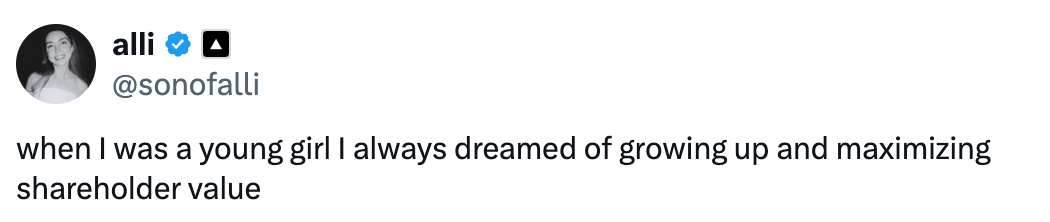
(No you didn't, Alli.)
And so, when I say this, I say it with dissonance and seriousness, knowing it will truly affect millions of jobs that have kept people employed, while simultaneously removing activities people were only dutifully pretending to enjoy: Type Talk jobs will be swept away in an uncomfortable, years-long grind, complete with garburator-style chomping and whooshing sounds.
I move to the next question: "and then what?"
In my mind, there will always be work for those that are ready for realness. If there is work ahead that involves relationships, embodiment, analog and live experiences, it's likely worth investing some energy in. Handy acronym alert: R.E.A.L.
R: Relational
This is the human work of bringing attunement, presence and humanity to interpersonal interactions. (While it's true some folks find depth and value in bot-interactions for relationships, there is a lack of "sacred witnessing" here that results in loneliness and eventual disenfranchisement and warrants caution.) To me, the cluster of jobs that focus on care and presence remain high-priority: therapists, social workers, early childhood educators, elder care workers, etc.
E: Embodied
If you're in your body, touching matter, it'll matter. Engaging in the physicality of bodily interaction to reach another human and make a difference. (Yes, I know, physical robots and delivery drones. Stop it. I mean the literal flesh-and-blood, heart-driven, human interactions where human bodies and hands are crafting, making, interacting, and shaping things.)
A: Analog
Making the physical, making the tangible, offline. Bake, cook, make, paint; make pottery, textiles, shoes; perform, sing, act, dance – and do it offline. The web-based stuff will soon be indistinguishable from fraud, inseparable from scams, irrevocably suspicious! The non-technological, the artisanal, the disconnected, it can only have a renaissance. Raise chickens, make sourdough, y'know?
L: Live
It's happening in front of you, in real-time. Not recorded, not generated, not mediated. Not flowing through fibre to appear on a screen. Flowing through the time/space continuum in front of your eyes, into your ears, right in front of your literal face. It can't help but come alive, as mere proof of not-fakeness.
Am I saying these will be fool-proof ways to make money? Gosh no; we know already that many of these lines of work are challenged. But it's true that "healthcare" and "education" have been the only recent sectors to see real job growth. It's true that even as robots learn to make art, it's primarily the digital-kind, on-screens – which means there's presently a "moat" (I do hate that word) that invites humans to participate in their unique human-ing: things you can touch, feel, see, grow, and love.
And it's here that there is valuable, life-giving work to do no matter what. You can do projects that will help with local, neighbourhood nurturing, that helps people thrive. You can:
- Host a guild-style workshop (like Charlotte's Circle of Repair project)
- Build out a physical space for creative collaboration, like Kelowna's new Creative Bloc campus
- Sign up for an outdoor pre-school, to remember how nature works, like the Clubhouse forest and farm pre-school. Teach kids in your world how to grow food, how to cook, how to do
- Learn new skills: like how to fix cars, how to dance, how to sing, how to sew, just for the joy and challenge of it.
The "R.E.A.L." acronym has been guiding me for the past year or so as I think about what to turn my own efforts to, and it's what has me prioritizing local initiatives, land-based work, relationally-driven connections, family-driven activities, over work that is exclusively digitally-mediated and information-based.
And yet, here I am writing words on the internet. Time to go make some lunch.